





Every fall, LaPorte homeowners get told their furnace needs replacing. Some of them do. But “repair or replace” is one of the easiest places in home services to be sold equipment you did not need, so it is worth knowing how the decision actually gets made. Dye Plumbing & Heating has been diagnosing furnaces in LaPorte County since 1939, and our guideline is straightforward: start considering replacement once a furnace reaches 15 to 20 years, or when a repair would cost more than half of replacing the unit — then confirm it with readings. Here is what those readings are, what the target numbers look like, and what each one rules in or out.
Two very different conversations can happen in your basement in October, and they look identical from the top of the stairs.
The first is a diagnosis. Somebody takes readings, tells you what they measured, and explains which findings are component-level and which are structural. You end up knowing what is wrong with your furnace.
The second is a recommendation with no evidence attached. The furnace is old, the technician looked at it, and the recommendation is a new system. Nothing in that chain is a lie. Nothing in it is a measurement either.
The difference matters because one finding ends the conversation on safety grounds: a breached heat exchanger. That is a carbon-monoxide path into the air your blower circulates, and no reputable contractor will patch one. It is also, for that reason, one of the most consequential sentences a homeowner can hear in their own basement — which is why the follow-up question is not rude. How did you determine that?
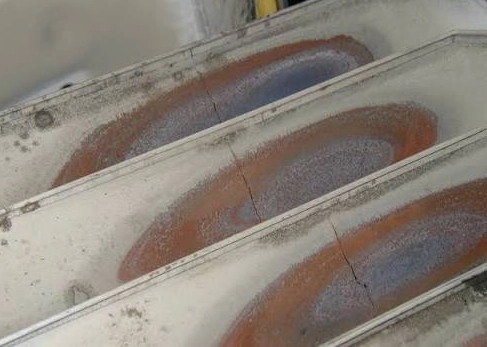
A furnace diagnosis is a sequence of instrument readings compared against published targets. Some of those targets are printed on the furnace itself.
The table below is what a competent gas-furnace diagnosis involves. The heat-exchanger portion — the ambient carbon-monoxide check, the flame-on-blower-start observation, the manometer isolation test, and the borescope — follows the diagnostic sequence published by HVAC School, a technician-training resource for the trade; the flame-sensing and temperature-rise targets follow the same publisher’s flame-sensing and temperature-rise guidance.
| What Gets Checked | How It Is Read | What the Reading Rules In or Out |
|---|---|---|
| Flame sensor | Microamp meter in series with the flame rod | Healthy is roughly 0.5 to 10 microamps depending on the furnace, with 2 to 6 most common. Below that window the control board shuts the gas valve — a furnace that lights, runs seconds, and quits. Component repair. |
| Temperature rise | Thermometers at return and supply, on high fire, after 15 to 20 minutes | Compared against the range printed on the furnace’s own data plate. Below the low end risks condensing inside the heat exchanger. At or above the high end, the furnace may begin cycling on its limit control — a sign airflow across the exchanger is restricted. |
| Ambient carbon monoxide | Combustion analyzer or personal CO instrument, in the living space, while heating runs | Anything other than zero is worth investigating. |
| Flame reaction on blower start | Direct observation | The burner and heat exchanger are isolated from the airstream, so the flame should not change when the blower energizes. Any change is an indication. |
| Heat exchanger isolation | Manometer probe in the exchanger, inlet and outlet sealed, gas off, blower running | Any pressure change is an indication of a leak. |
| Visual inspection | Mirror or borescope | Confirms what is visible. Does not rule out what is not. |
One row in that table deserves a second look: temperature rise, the reading almost nobody asks about.
Temperature rise is the difference between the air going into the furnace and the air coming out, and every furnace specifies an acceptable range on its data plate. Read it correctly and it tells you whether the problem is the furnace at all. Run below the low end and you can start forming condensation inside the heat exchanger, which corrodes it from the inside. Run at or above the high end and the furnace may begin cycling on its limit control, a safety control not designed to cycle regularly — and that points at insufficient airflow across the heat exchanger.
That second case is worth sitting with. A restricted duct, a collapsed flex run, or a filter nobody has changed can push a healthy furnace outside its own rise range and cook the heat exchanger early. The furnace is not dying of old age. Something upstream has been killing it.
Age is where this question starts, and it changes the shape of everything that follows.
Early on, failures are almost always components, and components are replaceable: an igniter, a flame sensor, a blower motor, a gas valve. Two things shift over time. The first is parts availability — at some point a control board for a particular model stops being stocked, and a cheap repair becomes an expensive scavenger hunt. That is a legitimate input to a replace decision and it has nothing to do with how the furnace is running. The second is cumulative wear on the one component that cannot practically be replaced on its own: the heat exchanger. Every cycle outside the rise range spends a little of it.
Which is why documentation is worth more than memory. If a technician gives you the readings each time, you accumulate a record — three years of readings tell you whether a furnace is stable or drifting. A single reading taken in an emergency in January tells you almost nothing.
Dye’s guideline is the place to start: consider replacement once a furnace reaches 15 to 20 years, or when a repair would cost more than half of what replacing the unit would. That is the frame most homeowners need, and it is the same one we work from.
What a guideline cannot do is tell you which side of the line your specific furnace falls on. A 17-year-old unit with a failed igniter and clean combustion readings is a repair. A 12-year-old one with a breached heat exchanger is not. So alongside the guideline, ask for the evidence.
Ask these:
At Dye, every repair proposal is clearly communicated before any work begins, and we can email your estimate.
And if a national chain has already quoted you on a replacement, get a second quote. We’re confident in ours.
Dye’s published position on furnace repair is that we don’t guess at furnace problems — we troubleshoot methodically to find the actual root cause. In practice that means checking thermostat settings, verifying power and gas supply, inspecting the ignition sequence, testing safety controls, checking electrical components, and measuring gas pressure. We check combustion, venting, and safety controls as part of every repair service, and we perform heat exchanger inspection.
We also repair at the component layer a replacement-first shop tends to skip past: igniter, flame sensor, blower motor, control board, gas valve.
Our HVAC technicians are NATE certified. Dye has three Indiana Plumbing Contractors on staff — the top license tier in the state — two Journeyman Plumbers, and one Registered Apprentice in Registered Apprenticeship Program #IN020104132. We are Google Guaranteed and rated 4.8 stars across 430+ Google reviews. We have been at 1600 Lake Street Suite B in LaPorte since 1939, and our technicians are not on commission.
Frost risk in LaPorte County arrives before the heating season is really underway, and that is the argument for doing this now. A diagnosis in September is a decision made with time. The same diagnosis in January is a decision made in an emergency, in the cold, with whoever can get there.
Dye Plumbing & Heating serves LaPorte, LaPorte County and Northwest Indiana with same-day emergency response during business hours. Every repair proposal is clearly communicated before any work begins, and we can email your estimate. Schedule a furnace diagnosis online or call 219-362-6251.
219-362-6251Dye Plumbing & Heating · 1600 Lake Street Suite B, LaPorte, IN 46350 · Indiana Plumbing Contractor License PC#10500518

© Red Barn Media Group 2026