





The first warm afternoon of the season in LaPorte is when central-air units announce what they were quietly hiding all winter. Homeowner flips the thermostat over, the unit hums to life, the fan spins — and the air at the registers is room temperature. The unit is running. That is the confusing part, and it is also a useful diagnostic signal. At Dye Plumbing & Heating in LaPorte, Indiana, we have been running spring-startup AC service since they were invented, and four common failure modes account for the overwhelming majority of “it’s running but it won’t cool” calls. The diagnostic that separates them takes a NATE certified technician about thirty minutes — and tells the homeowner exactly which component, not just “the AC is broken.” Every Dye spring-startup call ends with a copy of the inspection report in the homeowner’s hands — the same documentation that makes a second opinion easy to get.
If the outdoor unit is running and the indoor blower is moving air, two systems have already passed a real test: the thermostat circuit is working, and the breaker is holding. That narrows the failure to the refrigeration loop or the air-handling path — and within those, to a short list of components that fail in predictable ways after a winter off.
The four causes that produce the “running but not cooling” symptom are a failed run capacitor, a frozen evaporator coil, a refrigerant leak, and a blocked or dirty condenser coil. Three of those have nothing to do with refrigerant. Only one involves a leak. A diagnosis that names “low refrigerant” without putting gauges on the system has skipped the steps that would tell the homeowner which of the four is wrong.
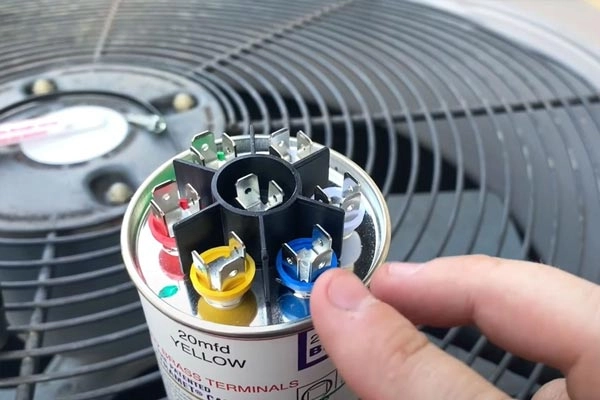
The symptom at the thermostat usually points at the failed component. The table below maps what a homeowner can see and hear to what an Indiana Plumbing Contractor or a NATE certified HVAC technician investigates first.
| What You Notice | What It Usually Points To, and What a Tech Should Check |
|---|---|
| Symptom at the Thermostat | |
| Fan running, registers warm | The cooling failure is downstream of the thermostat circuit. Power is fine; the refrigeration loop or air-handling path isn’t doing its job. Tech should put gauges on the suction and liquid lines first. |
| Visible ice on the suction line | Frozen evaporator coil. Surface temperature has dropped below 32°F because of either low refrigerant or low airflow. Thawing it doesn’t solve it — the underlying cause has to be found. |
| Condenser fan running, unit short-cycling | Most often a failed run capacitor, sometimes a refrigerant pressure issue. A capacitor microfarad reading against nameplate spec settles it in 30 seconds. |
| Hard “click” then nothing on startup | Almost always the capacitor. The compressor tries to start, the capacitor can’t deliver the kick, and the compressor gets hot. Common spring-startup failure mode after a winter of non-use. |
| What a Real Diagnostic Includes | |
| Gauges on suction + liquid lines | Pressure readings on both sides — without these numbers, refrigerant diagnosis is a guess. Superheat and subcooling math separates a charge issue from an airflow issue. |
| Capacitor microfarad measurement | A multimeter reads the capacitor’s actual capacitance against the nameplate value. A reading outside the rated tolerance is the cause, not a symptom. |
| Coil inspection — both sides | Evaporator coil checked for ice and contamination. Condenser coil checked for blockage from leaves, cottonwood seed, or built-up grime. Either condition compounds every other failure. |
| Filter and blower check | A clogged filter or a failing blower can mimic a refrigerant issue from the thermostat. Ruled in or out before any refrigerant work begins. |
Field-tech experience and HVAC trade press consistently identify run capacitors as the most common single cause of spring-startup AC failure. Capacitors degrade during off-season storage when the dielectric isn’t refreshed by regular use, and the first warm afternoon of the season is when the weakened capacitor finally drops out. A frozen evaporator coil is the second-most-common symptom — and the one most easily misdiagnosed if the technician arrives, sees ice, and adds refrigerant without checking airflow first. The four-step diagnostic above keeps that mistake from happening.
A residential central-air unit running on R-410A or, in newer installs, R-454B has predictable wear patterns. Run capacitors degrade roughly on a five-to-ten-year curve. Evaporator coils accumulate dust and biological film year over year that lowers heat-transfer efficiency. Refrigerant leaks rarely show up as one big event — they show up as a slow charge loss over multiple summers, where last year’s cooling was “fine, maybe a little slow” and this year’s is “not cooling at all.”
Year-over-year documentation catches all three. A capacitor microfarad reading recorded during last May’s spring-startup call, compared to this May’s reading, tells the technician how much margin is left. A coil inspection note about dust loading or visible algae lets the homeowner schedule a coil cleaning before the August heat wave forces the issue. A subcooling reading that has crept three degrees in twelve months is a refrigerant leak announcing itself a year before the system loses cooling entirely. The cost of writing those numbers down is zero. The cost of not having them is the late-July emergency call.
The broader market context matters: according to S&P Global, private-equity deal share in the home-services industry has accelerated significantly in recent years — a cost structure built on national marketing budgets, commissioned sales technicians, and investor returns eventually shows up somewhere on the homeowner’s invoice. The pattern that surfaces most often on “AC won’t cool” calls is the early refrigerant pitch: the technician arrives, doesn’t put gauges on the system, doesn’t measure the capacitor, and suggests the unit needs “some refrigerant added” — sometimes paired with a chain-replacement pitch in the $12,000 to $15,000 range before the diagnostic is even done.
Industry reporting from EIN Press notes that more than 500 independent home-services contractors have begun publishing their install prices online specifically because of how this funnel has come to dominate the industry. Adding refrigerant without finding the leak is the practice the EPA identifies as a non-compliant pattern in stationary refrigerant systems — and the standard every NATE certified technician follows regardless of system size is leak detection before recharge. Here is what to ask before you write a check on any spring-startup AC repair:
A quote that fails any of those questions isn’t necessarily dishonest — but the visit was designed to sell, not to diagnose. The technician who runs the gauge-and-capacitor diagnostic, names the failed component, and leaves before pitching anything else is the one earning the call back. Dye’s standard practice is to leave a copy of the inspection report with the homeowner before the truck pulls away — the same documentation that makes a second opinion easy to get if you want one. We’re confident in our quotes, and we’ll gladly take a look at an estimate a national chain already wrote up.
Dye Plumbing & Heating was founded in LaPorte in 1939 — 87 years of serving Northwest Indiana homeowners. Our team holds Indiana Plumbing Contractor License PC105000518 (the top license tier in the state) and includes three Indiana Plumbing Contractors, two Journeyman Plumbers, and one Registered Apprentice in our Registered Apprenticeship Program #IN020104132. Our HVAC technicians are NATE certified and we are a Google Guaranteed provider. Our technicians are not on commission, and our customers have left 405 verified Google reviews at a 4.8-star average. Every spring-startup AC service call we run starts with gauges on the system, a capacitor microfarad reading, and a coil inspection — and ends with a copy of the inspection report the homeowner keeps.
To schedule a spring-startup AC diagnostic in LaPorte, Michigan City, Valparaiso, or the surrounding Northwest Indiana service area, call Dye Plumbing & Heating at 219-362-6251 or request an appointment at dyeplumbing.com. We’ll send a NATE certified HVAC technician with gauges, a capacitor meter, and a coil-inspection camera — and you’ll receive a copy of the inspection report.
219-362-6251
© Red Barn Media Group 2026