





A LaPorte County homeowner described a service call she remembered well: in 2023, recharging the refrigerant in her air conditioner cost about $195. Three years later, the same recharge on the same system landed several hundred dollars higher. Nothing about her air conditioner had changed. The refrigerant market did. At Dye Plumbing & Heating in LaPorte, Indiana, we have been installing and servicing residential air conditioning since it was invented, and we are getting a lot of questions about the refrigerant rule that took effect last January. Here is a calm, technical breakdown of what actually changed — and what it means for your specific system over the next five years.
Wholesale prices on R-410A — the refrigerant in most air conditioners installed across NW Indiana over the past decade — have risen sharply since the new federal manufacturing rule took effect on January 1, 2025. We have heard versions of the same story from homeowners across LaPorte County: a routine refrigerant recharge that ran around $195 a few years ago now lands on an invoice three to four times higher. Nothing was overcharged. Nothing in the system changed. The wholesale cost of R-410A simply rose because the new EPA rule cut off domestic manufacturing of new R-410A residential equipment, and demand for the existing supply tightened. That cost change is real, and it is showing up on routine service tickets right now.
That economic shift is the actual mechanism behind the headlines. It is not a deadline forcing anything. It is a market change — and it is the most important fact for any homeowner trying to decide what to do next with an existing R-410A system.
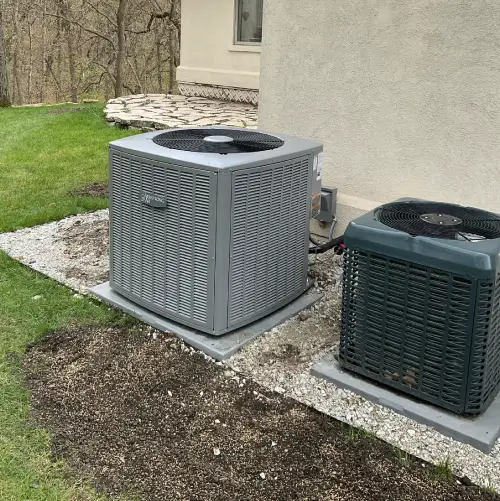
The change is part of a federal regulation called the AIM Act, passed in 2020, which directs the EPA to phase down high-global-warming-potential refrigerants used in air conditioning and refrigeration. The implementing rule locked in two key dates that NW Indiana homeowners need to know:
Starting now, every new air conditioner installed in LaPorte County uses one of the EPA-approved low-GWP refrigerants — most commonly R-454B. Here is how the two compare side by side:
| Specification | R-410A (legacy) | R-454B (new standard) |
|---|---|---|
| Approximate GWP (100-year) | ~2,088 | ~466 |
| ASHRAE flammability class | A1 (non-flammable) | A2L (mildly flammable) |
| Operating pressure range | Slightly higher | Slightly lower; similar overall range |
| Compressor oil type | POE (synthetic) | POE (synthetic) |
| Factory leak-detection sensor | Not required; not installed | Required by code; factory-installed |
| New US residential split-system manufacture allowed after Jan 1, 2025 | No | Yes |
| Existing installed systems legal to operate and service | Yes — indefinitely | Yes |
The A2L flammability class is the line item that gets the most attention in sales pitches. In practice, A2L refrigerants require very specific conditions — confined volume, ignition source, sustained leak — to ignite, conditions that do not exist in normal residential operation. Code now requires every R-454B residential system to ship with factory-installed refrigerant detection sensors near the evaporator coil that monitor concentration and trigger automatic shutdown if levels exceed safe thresholds.
One important corollary: R-454B is not a drop-in replacement for R-410A. Despite some performance similarities, the two refrigerants are listed for different equipment under different safety standards. You cannot put R-454B into an R-410A condenser, and you cannot pair an R-454B condenser with an R-410A indoor coil. Mixing the two between mismatched equipment is an active safety hazard — the leak-sensor protection that R-454B equipment is built around does not exist on the R-410A indoor coil side. If a contractor proposes a partial system swap that mixes refrigerant types, that is a flag, not a solution.
The most important thing to understand is this: your existing R-410A system is not obsolete. It is legal to operate, legal to service, and parts and refrigerant remain available. Service shops will keep stocking R-410A for the working lifespan of installed equipment. So what does the next five years actually look like for a homeowner whose AC runs R-410A?
Three trends to plan around. First, R-410A refrigerant prices will keep climbing as supply tightens. Recharge costs on existing systems will continue to rise. That is not a contractor markup; it is the wholesale market. Second, parts and routine service stay routine. Capacitors, contactors, fan motors, and most repair parts are not refrigerant-specific, so service availability is not the constraint. Third, the math on repair-versus-replace tilts gradually as the system ages.
The conditions where replacement starts to make real financial sense are specific: a failed compressor on a 12-plus-year-old R-410A unit where the rebuild cost approaches new-equipment cost; a major coil leak that requires a $2,500-plus coil replacement combined with a full recharge; a documented efficiency drop that is materially raising your monthly cooling bill. A unit that holds charge, cools to spec, and shows good airflow with no efficiency drop is not a candidate for premature replacement — regardless of what refrigerant it uses.
The honest framework is not “you must replace,” and it is not “you should never replace.” It is “here are the conditions under which each makes sense for your specific system.” That requires a documented diagnostic on the equipment that you already own.
The home-services industry has been consolidating rapidly. According to S&P Global, private-equity deal share in the HVAC industry jumped from 8 percent of transactions in 2023 to 23 percent in 2024, with add-on acquisitions up 88 percent year over year through June 2025. Industry reporting from EIN Press notes that hundreds of independent HVAC contractors have begun publishing their install prices online specifically as a counter-move to that consolidation. The reason transparency matters more in 2026 than it did five years ago is that the cost structure of a PE-owned shop — corporate marketing, commissioned sales reps, ticket-average targets — eventually has to land somewhere on the homeowner's invoice.
Before you sign any AC replacement quote in 2026, ask:
A fair quote answers every one of those questions in writing. A pressured quote tries to get you past them.
For context only — not as a price comparison against any specific company — chain replacement pitches in NW Indiana commonly land in the $12,000 to $15,000 range. Independent shops in the area, including ours, typically quote comparable equipment in the $7,000 to $10,000 range depending on tonnage, SEER2 tier, and install complexity. The gap is not equipment. It is overhead.
Dye Plumbing & Heating was founded in LaPorte in 1939 — we are in our 87th year servicing Northwest Indiana homeowners. Our technicians are NATE-certified. Three Indiana Plumbing Contractors, two Journeyman Plumbers, and one Registered Apprentice are on staff, under Indiana Registered Apprenticeship Program #IN020104132 and Plumbing Contractor License PC105000518. We are a Google Guaranteed provider with a 4.8-star average across 403 verified Google reviews. Our technicians are not on commission. When you call us about an existing R-410A system, we will tell you what the diagnostic numbers actually show — and when replacement makes financial sense, we will show you the math, in writing, before any work begins.
To schedule a no-pressure assessment of your existing air conditioning system in LaPorte, Michigan City, Valparaiso, or anywhere across Northwest Indiana, call Dye Plumbing & Heating at 219-362-6251 or request a visit at dyeplumbing.com. We will give you the actual diagnostic condition of your system and your real options for the next five years — keep running, plan-ahead replacement, or replace now — in writing, before any work begins. No commissioned salespeople. No surprise refrigerant-deadline pitch. Just the numbers your system is actually producing.
219-362-6251
© Red Barn Media Group 2026