





When a gas water heater loses hot water or won’t keep its pilot lit, there’s usually a small light blinking on the gas valve — and that light is a diagnostic code. Most homeowners never learn to read it. Neither does the technician who glances at it and quotes a whole new heater. At Dye Plumbing & Heating in LaPorte, Indiana, we’ve diagnosed and repaired water heaters since 1939, and that code is where an honest repair-or-replace decision starts. Here’s what the blinking light is telling you, the one test that separates a cheap fix from a real failure, and how to decide whether to repair the valve or replace the tank.
Modern gas water heaters don’t just sit there until they quit. The gas control valve runs a small diagnostic system, and when something is wrong it tells you — in blinks. A pattern of two flashes, a pause, then two flashes again is the valve reporting a specific condition. The problem is that the blink code is easy to ignore and even easier to misread. A technician working a high-volume replacement funnel has every reason to skip it: reading the code points toward a targeted repair, and a targeted repair isn’t a new water heater.
So, the same symptom — no hot water this morning, a pilot that won’t stay lit — produces two very different visits. One reads the code, runs a test, and tells you exactly what failed. The other glances at the puddle or the dead pilot and reaches for a replacement quote. Knowing what the light means puts you back in control of that conversation before anyone is in your basement.
If you’re asking what that blinking light actually means, the answer is that it’s a diagnostic code from the gas control valve — one flash is normal, two flashes means low thermopile voltage, and seven flashes means the electronics have failed — because the valve is built to report its own condition before it shuts the burner down.
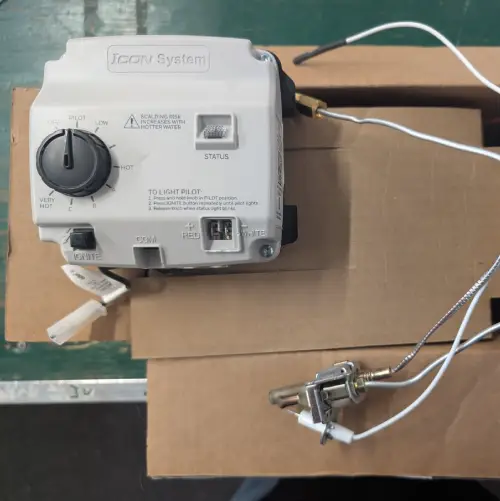
On a Bradford White — the brand Dye installs — and on many A.O. Smith and Rheem standing-pilot units, that control is a Honeywell/Resideo gas valve, powered by a thermopile heated by the pilot flame rather than by house electricity. The manufacturer’s own service literature from Resideo lays out exactly what each blink pattern means. These are the codes you’re most likely to see:
| Status Light Pattern | What It Means — and What Dye Does |
|---|---|
| 1 flash every 3 seconds | Normal. The electronics are holding the pilot open and the burner closed. No action needed. |
| Strobe every 3 seconds | Normal. A call for heat — the main burner is firing to bring the water up to temperature. |
| 2 flashes | Low thermopile voltage — the most common code. The thermopile that powers the valve isn’t producing enough current. We meter its output (healthy is at least 350 millivolts) to tell a worn thermopile from a failing gas valve. |
| 4 flashes | Temperature cut-out limit reached. We check the gas valve, the water-temperature sensor, and the setpoint before going further. |
| 5 flashes | Water-temperature sensor failure. We test the sensor and its connection for opens, shorts, or drift. |
| 7 flashes | Electronics failure. The control module — the gas valve itself — needs to be replaced. |
| 8 flashes | Warning only. The control still senses power with the knob in the OFF position; we inspect the valves. |
| Solid (steady) light | Not an error. The control is in the OFF position. |
The code narrows the diagnosis, but it doesn’t finish it. A two-flash “low thermopile” code is the perfect example: it can mean a dirty or worn thermopile, a weak pilot flame, or a gas valve on its way out. The blink tells you where to look. The next step tells you what to fix.
The next step is a meter. With the pilot lit, a technician reads the thermopile’s output against the manufacturer’s floor of at least 350 millivolts. That single reading is what separates an inexpensive thermopile from a failed gas control valve from a tank that is simply finished. A shop that never puts a meter on the thermopile can’t tell those three apart — so it defaults to the most expensive one, the whole heater.
Because a water heater gas valve is a live gas component, the correct repair doesn’t end when the part is swapped. It ends with a soap-and-water gas leak test at every joint that was opened. That is the step a parts-swap-and-go skips, and it’s the one that protects your home rather than just your hot water. When the work is done, you get a plain account of what the code was, what the meter read, and what was replaced — a copy of the diagnosis you can keep, not just a charge on a card.
Once you know what failed, the repair-or-replace decision is mostly arithmetic. Age is the first input. The manufacturer A.O. Smith puts a tank water heater’s typical life at 8 to 12 years and recommends replacement once a unit is past about 10 years and shows a leaking base, rusty water, or erratic operation. The second input is the 50 percent rule: when a repair would cost more than half the price of a new heater, replacement is the smarter money. A failed gas valve on a 6-year-old tank is usually worth fixing. The same valve on a 13-year-old tank often is not.
A leaking tank is its own answer — the steel has corroded through and that isn’t a repair, it’s a replacement. A thermostat, a thermopile, or a gas valve on a younger tank usually is. The way to tell the difference on paper is to make the quote show its work. Before you approve anything, ask:
A quote that can answer those is a diagnosis. A quote that jumps straight to “you need a new water heater” without the code or the meter reading is a sales pitch wearing a tool belt.
Founded in LaPorte in 1939, Dye Plumbing & Heating has served Northwest Indiana for 87 years. Our field team includes three Indiana Plumbing Contractors — the top license tier in the state — two Journeyman Plumbers, and one Registered Apprentice in Registered Apprenticeship Program #IN020104132, and every job is performed under Indiana Plumbing Contractor License PC#10500518. Our technicians are NATE certified, we’re a Google Guaranteed provider, and we don’t put anyone on sales commission. Our customers have left a 4.8-star average across 400+ Google reviews. On a water heater, that means we read the code, meter the thermopile, finish with a gas leak test, and hand you the diagnosis before we leave.
If your water heater’s status light is blinking or the pilot won’t hold, call Dye Plumbing & Heating at 219-362-6251 or request a visit online. We serve LaPorte, Michigan City, Valparaiso, and the surrounding Northwest Indiana area. We’ll read the code, meter the thermopile, and tell you whether it’s a part or a tank — and we’ll hand you a copy of the diagnosis before we leave, so the decision is yours.
219-362-6251
© Red Barn Media Group 2026