





You walked into the bathroom and the floor around the toilet base is wet. That’s a moment that calls for a thirty-second decision: is this an emergency, is this a homeowner fix, is this a plumber call. At Dye Plumbing & Heating in LaPorte, Indiana, we have been running residential plumbing diagnostics since 1939, and toilet-base leak calls in LaPorte and across LaPorte County follow a predictable pattern. The most common cause is a failed wax ring, and the diagnostic that separates a wax-ring fix from a flange-and-sub-floor repair takes a Dye plumber under an hour. The most common failure mode you should know about in an older LaPorte home is something different: a rusted cast-iron closet flange under the toilet. Every Dye toilet-base diagnostic ends with a copy of the inspection report in the homeowner’s hands (the same documentation that makes a second opinion easy to get).
The first useful diagnostic split is whether water shows up only after a flush or independent of one. Water that pools only after a flush is almost always a wax-ring failure, meaning the seal between the toilet’s horn and the closet flange has stopped holding. Water that pools without a flush is something else: a leaking supply line, a sweating cold tank, or a cracked toilet bowl letting water seep slowly.
Five causes account for most toilet-base water in any home: wax ring, loose tank-to-base bolts, supply-line leak, condensation, or a cracked bowl. The cause LaPorte homeowners should know about is a sixth that hits older NW Indiana housing stock harder than the rest: a rusted cast-iron closet flange. When the flange surface has degraded at the bolt-slot perimeter, a same-for-same wax-ring replacement can fail inside a month. The new ring is sealing against a corroded edge. The leak comes back, and the second visit costs more than the first one would have if the flange had been diagnosed up front.
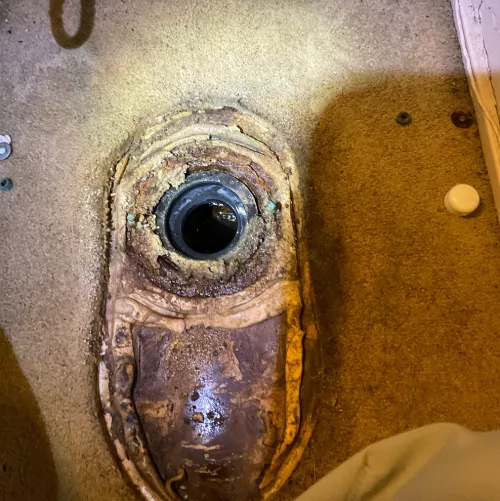
The symptom at the floor usually points at the failed component. The table below maps what a homeowner can see and smell to what an Indiana Plumbing Contractor investigates first.
| What You Notice | What It Usually Points To, and What a Plumber Should Check |
|---|---|
| What You See or Smell | |
| Water only after a flush | The wax ring under the toilet base has failed. The seal between the toilet horn and the closet flange has lost its compression. Toilet must be pulled, flange inspected, ring replaced; or, replaced as a set if the flange is corroded. |
| Water without a flush, slowly pooling | Either condensation on a sweating tank in a humid bathroom, or a slow leak at the supply-line angle stop. Run the supply-line dry-check first; if dry, look at tank-to-bathroom temperature differential. |
| Water without a flush, visible drip at the wall | The flexible braided supply line or the angle-stop shutoff valve has failed at the wall connection. Both are ten-minute homeowner-or-plumber fixes. |
| Toilet rocks front-to-back when you sit | The tank-to-base bolts are loose, OR the closet flange has separated from the floor. Tightening the bolts addresses the first case; the second needs the toilet pulled and the flange anchoring inspected. |
| Sewer-gas smell rises with water | The wax ring is fully compromised. The seal is gone and sewer gas is venting around the toilet base. Toilet must be pulled the same day; do not delay. |
| What a Real Diagnostic Includes | |
| Flush test + base-rock test | Plumber runs the toilet and watches the base perimeter to confirm wet-after-flush vs wet-without-flush. Hand pressure on the toilet body checks for rock indicating loose bolts or a separated flange. |
| Supply-line dry-check | Towel-wipe and dry the supply line from the angle stop up to the tank inlet, then re-inspect after a flush cycle. Differentiates a tank-side leak from a supply-side leak from a wax-ring leak. |
| Sub-floor pen-probe at the base perimeter | A blunt probe at the base perimeter checks for sub-floor softness, an early indicator of chronic moisture penetration around the flange before the leak became visible. |
| Flange visual after the toilet is pulled | The toilet comes off. Flange surface is mapped for corrosion at the bolt slots, a common failure mode in NW Indiana older housing stock running cast-iron flanges. New ring, new bolts, or a flange repair and replacement when the surface has degraded. |
| Sub-floor probe under the flange | Hidden sub-floor decay under the flange is documented before the toilet is reset. Customer sees every finding photographed on the inspection report. |
Industry literature consistently identifies wax-ring failure as the dominant cause of toilet-base leaks, with service life typically falling in the range of a decade or so depending on installation quality and lateral movement of the toilet over time. Manufacturer installation guidance from Oatey (the most common wax-ring supplier in residential plumbing) emphasizes that compression set and shifting of the toilet body are the dominant failure modes, which is the technical reason a toilet that rocks predicts a wax-ring failure within months. Trade-press coverage in Plumbr magazine documents closet-flange failure modes. Corrosion of cast-iron flanges at the bolt-slot perimeter is recognized in the field as a regional pattern, more common in older housing stock where the original-install flange has been exposed to chronic moisture for decades. NW Indiana’s older stock fits that profile. The diagnostic ladder above keeps the wrong fix from being sold.
A wax-ring leak fixed within a week leaves no lasting damage. A wax-ring leak seeping for a year migrates moisture into the sub-floor at the flange perimeter, and from there into the floor joist below the toilet. The homeowner doesn’t see it; the toilet base hides the damage. The probe-under-the-flange step in the diagnostic ladder catches it before a second wax-ring swap fails for the same reason.
Year-over-year documentation matters because chronic moisture takes years to become an emergency and minutes to write down when caught early. A sub-floor pen-probe note this year, compared to the next inspection, tells the next plumber whether the moisture penetration has stabilized. A flange-condition photo on the customer copy of the report becomes evidence the homeowner can show to a contractor doing a future bathroom remodel. The cost of writing those notes down is zero. The cost of not having them is the second visit and a damp floor joist nobody knew about until the tile cracked.
Not every toilet-base leak call ends in a fair quote. The broader market pattern matters: according to S&P Global, private-equity deal share in home-services has grown rapidly — a cost structure built on national marketing budgets, commissioned sales technicians, and investor returns eventually shows up on the homeowner’s invoice. The pattern that surfaces on toilet-base leak calls is the lead-generation visit: a $79-diagnostic-credited-toward-repair offer brings the technician to the door, and the visit is designed to sell a wax-ring swap whether the underlying flange is sound or not. The leak returns inside a month because the cause wasn’t diagnosed.
Here is what to ask before you write a check on any toilet-base leak repair:
A quote that fails any of those questions isn’t necessarily dishonest, but the visit was designed to sell, not to diagnose. The plumber who runs the full diagnostic ladder, photographs the flange, names the failure mode, and quotes the fix that actually addresses it is the one earning the call back. Dye’s standard practice is to leave a copy of the inspection report with the homeowner before the truck pulls away, providing the documentation that makes a second opinion easy. We give free quotes on new-system installs. Service call diagnostics are charged separately.
Founded in LaPorte in 1939, Dye Plumbing & Heating has been serving Northwest Indiana homeowners for 87 years. Our team holds Indiana Plumbing Contractor License PC#10500518 (the top license tier in the state) and includes three Indiana Plumbing Contractors, two Journeyman Plumbers, and one Registered Apprentice in our Registered Apprenticeship Program #IN020104132 (USDOL-registered). Our HVAC technicians are NATE certified and we are a Google Guaranteed provider. Our plumbers are not on commission, and our customers have left 410 verified Google reviews at a 4.8-star average. Every toilet-base leak call we run starts with a flush test, a supply-line dry-check, a sub-floor pen-probe, and a flange visual after the toilet is pulled, and ends with a copy of the inspection report the homeowner keeps.
To schedule a toilet-base leak diagnostic in LaPorte, Michigan City, Valparaiso, or the surrounding Northwest Indiana service area, call Dye Plumbing & Heating at 219-362-6251 or request an appointment online. We send an Indiana Plumbing Contractor with the diagnostic ladder ready to run — flush test, supply-line dry-check, sub-floor probe, and a flange visual after the toilet is pulled. You’ll receive a copy of the inspection report with every finding photographed before we leave.
219-362-6251
© Red Barn Media Group 2026