





Every winter someone in LaPorte asks us the same question as soon as the furnace quits: how long do I have before the pipes freeze? Nobody can give you a number for your house without knowing where your pipes run. Dye Plumbing & Heating has worked on LaPorte County plumbing since 1939, and the houses here are not interchangeable — a 1920s foursquare with supply lines in an uninsulated crawlspace behaves nothing like a build from 2015 with every run inside conditioned space. What we can give you is what actually decides it: which pipes are the exposed ones, when the local risk window opens, and what to do first after the heat goes out.
Search this question and you will find confident answers. Treat them carefully: the outdoor temperature is not what breaks a pipe. The temperature around the pipe is, and that is a property of your house, not the forecast.
Four things set the timeline, and they vary enormously between two houses on the same street: how well the envelope holds heat, how cold it is outside, whether wind is driving air through gaps in that envelope, and — the one that matters most — whether your supply lines run through heated space or through a crawlspace, an exterior wall cavity or an attached garage.
That last one is decisive. A pipe inside conditioned space is protected by the thermal mass of the whole house and will be fine long after the thermostat reads cold; a pipe in an unheated crawlspace tracks the outdoor air almost directly and does not care what your thermostat says. It is why two neighbors can lose heat in the same storm and have very different mornings. So the useful question is which pipes are on the wrong side of the insulation — and that one you can answer in before winter, in daylight, without an emergency.
A burst pipe is a pressure failure, not an ice failure, and the difference changes what you do about it.
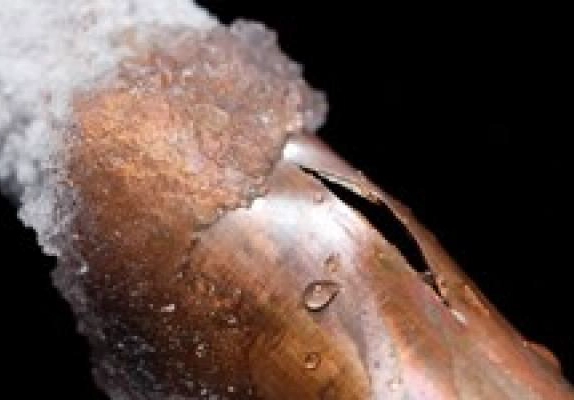
Water expands as it freezes. Once an ice plug forms in a run, that expansion drives pressure into the water still trapped between the plug and the next closed fixture. It is that trapped pressure, not the ice itself, that splits the pipe — which is why the failure is often not at the frosted section you can see. It is somewhere downstream, in the closed length between the ice and a shut tap.
This has a direct practical consequence, and it is the single most useful thing in this article: opening a fixture on the affected run removes the closed section. A thin stream from the tap furthest along that line gives the pressure somewhere to go. It does not thaw the pipe and it does not fix the heating problem, but it is the difference between a pipe that thaws out uneventfully and a pipe that splits inside a wall. If one has already split and water is running, close the main shutoff before anything else. Dye Plumbing & Heating tells callers to do both while a technician is on the way.
Where those vulnerable runs sit is consistent enough across LaPorte’s housing stock that our technicians check them in a fixed order:
| Where the Pipe Runs | Why It Is Exposed | What It Means for You |
|---|---|---|
| Exterior wall cavity | Common in the pre-war stock around the older parts of LaPorte. Only the interior drywall separates the run from outdoor temperatures. | Highest-risk location in an older home. Often invisible until it fails. |
| Unheated crawlspace | Frequently under an addition that was never brought up to the main envelope, so it tracks outdoor air. | The most common freeze location we find, and the easiest to insulate before winter. |
| Attached garage or utility room | Shares an exterior wall and gets opened to outside air every time the door goes up. | Risk rises sharply on any day the garage door is used repeatedly. |
| Hose bibb and its interior stub | An attached hose holds a column of water against the valve seat, where it cannot drain back. | The one homeowners consistently miss. Disconnect hoses before first freeze. |
Note the order: we inspect by exposure, not by symptom. The fixture that stopped delivering water tells you a pipe froze somewhere, not which one — and while you work backwards from the symptom, a second run can freeze.
At the nearest long-record weather station to LaPorte County, the average first freeze falls in mid-October and the average first hard freeze in early November. That record runs back to the 1890s and the extremes are wide — a first freeze has arrived as early as the third week of September and as late as the second week of November — which is why a calendar date is a planning tool rather than a guarantee.
That gives you a working window. September and early October are when exposed runs can be found and insulated, hoses can come off the bibbs, and a crawlspace can be inspected while it is still comfortable to work in. The same job in January is done in the dark and the cold, usually after something has gone wrong. Houses drift toward exposure over time too — insulation settles, an addition gets its plumbing routed the fast way rather than the warm way — so a run that has been fine for fifteen winters is not automatically fine for the sixteenth.
If you are calling anyone about a frozen or burst pipe, these questions separate a real diagnosis from a guess:
On thawing there are two real hazards. The first is fire: torches and propane heaters ignite framing, insulation and vapor barrier inside wall and crawlspace cavities, where the flame is out of sight until the structure is alight. The second is trapped steam: concentrated heat on a still-closed iced section can flash water to steam, and steam with nowhere to vent is a rupture risk rather than a slow leak. Both are why the fixture gets opened first. Low, broad, sustained heat — a hair dryer or heat lamp, never an open flame — worked from the open-fixture side inward is the controlled approach.
Dye Plumbing & Heating Service Co. has served LaPorte County since 1939. We hold Indiana Plumbing Contractor License PC#10500518, and our staff includes three Indiana Plumbing Contractors, two Journeyman Plumbers and a Registered Apprentice through our Registered Apprenticeship Program, #IN020104132. We hold 4.8 stars across 435+ Google reviews and we are Google Guaranteed.
On a no-heat call in freezing weather we ask two questions before dispatching: how long the house has been below normal temperature, and whether any fixture has stopped delivering water. If one has, a pipe is already frozen and the plumbing side starts in parallel with the heating diagnosis rather than behind it. Because we work both sides of the same house, both halves are handled on one visit.
The exposed runs in your house can be found now, while it is still comfortable to get into a crawlspace. Dye Plumbing & Heating serves LaPorte, Michigan City, Valparaiso, Rolling Prairie and Northwest Indiana, with same-day emergency response during business hours. Call 219-362-6251, Monday through Friday 7AM to 5PM or Saturday 7:30AM to noon, or contact us online. Every repair proposal is clearly communicated before any work begins, and we can email your estimate.
219-362-6251
© Red Barn Media Group 2026