





The boiler in the basement is firing, the thermostat upstairs is calling, and the bedrooms are still cold. The natural conclusion is that the boiler is failing, and sometimes it is. But on a two-story house, one of the first things worth ruling out is a reading most homeowners have never looked at: the system pressure on the gauge at the front of the boiler. Dye Plumbing & Heating has repaired boilers in LaPorte since 1939, and the number on that gauge explains a lot about cold second floors.
Dye’s boiler repair page lists the problems homeowners call about, and several of them describe this picture: “Fires but no heat reaches radiators,” “Heat reaches some zones but not others,” “Short cycling,” and “Pressure too low.” On a two-story house they often turn up together. The first floor is comfortable. The second floor is cold, and the radiators or baseboard up there may not heat or may be noisy, which Weil-McLain’s own troubleshooting table ties to air in the system or low system pressure. Meanwhile the boiler keeps switching on and off.
More than one fault can produce that. A circulator that has stopped moving water, or a zone valve stuck closed, will leave rooms cold while the boiler runs. Low system pressure and trapped air are a common cause worth ruling out before anyone condemns the boiler, and they leave evidence you can see from the basement, on the gauge.
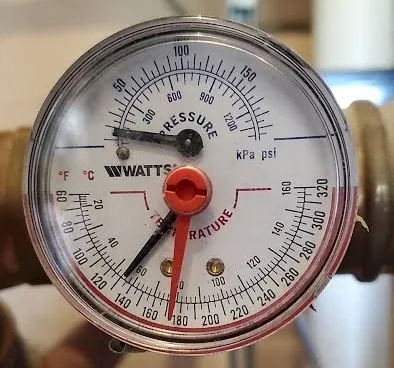
A closed hot-water heating system is a column of water, and water has weight. As PHCP Pros sets out in its Radiant Insider column, every foot of height adds about 0.43 psi at the bottom of the system. A typical two-story house with baseboard and the boiler in the basement has a system about 16 feet tall, so it takes roughly 7 psi at the boiler just to push water to the top. At 7 psi the gauge in the basement shows pressure, but the pressure at the highest radiator is zero.
That is why about 12 psi is the common cold setting for that house: the extra 5 psi keeps positive pressure at the top. It matters because at zero, and for a moment below zero when the circulator starts, automatic air vents at the high points can let air in instead of pushing it out. The air collects at the highest radiators or baseboard until they airlock and give no heat at all.
| System | Height (Typical Example) | Cold Fill at the Boiler | Left at the Top |
|---|---|---|---|
| Two-story, boiler in the basement | About 16 ft | About 12 psi | About 5 psi |
| Three-story, boiler at the bottom | About 24 ft | About 15.5 psi | About 5 psi |
| Your boiler | Check the manual | Some manufacturers set a higher floor | Positive, never zero |
Figures in the first two rows are the PHCP Pros example, not a measurement of any particular house. Your boiler’s own manual may set a higher minimum: Lochinvar’s Knight manual says the boiler is designed for a system of not less than 12 psi. At the other end, the Knight manual lists a 30 psi relief valve setting, and Weil-McLain’s user manual makes its daily check for its water boilers a gauge reading not over 24 psig.
An airlocked upstairs zone can starve the boiler of flow, and Weil-McLain’s troubleshooting table lists insufficient water flow through the boiler as a cause of rapid cycling: the boiler reaches its limit quickly, shuts off and starts again, while the rooms that called for heat still do not warm. The burner is firing, but the heat is not reaching the rooms that asked for it. Weil-McLain’s John Kopf, writing in ACHR News about commercial boiler selection, notes that the longer a boiler runs without cycling, the higher its seasonal efficiency.
The fuel costs more than it did. Indiana’s average residential natural gas price was $11.49 per thousand cubic feet in 2025, up from $9.50 in 2024 and back to about where it sat in 2022 and 2023, according to the U.S. Energy Information Administration. A system that keeps losing pressure adds a second cost: if the fill valve keeps topping it up, fresh water keeps coming in, and Weil-McLain warns that mineral buildup from continual make-up water reduces heat transfer and overheats the metal.
Low pressure is not the same as no water. According to McDonnell & Miller, a low-water cutoff is the only device that can tell whether water is present, and it shuts the burner off before the boiler dry-fires. Weil-McLain’s EG boiler manual says one is required when a boiler is installed above the level of the radiation, or by certain state or local codes or insurance companies, and its user manual tells owners to test the low-water cutoff periodically during the heating season. On a steam boiler it works alongside the gauge glass that shows the water level. If a boiler has run low and is still hot, do not add water to it. Weil-McLain’s manual says it plainly: “Do not add cold water to a hot boiler. Thermal shock can cause the heat exchanger to crack.”
A cold second floor is not by itself a reason to replace a boiler. These questions separate a diagnosis from a guess:
At Dye, every repair proposal is clearly communicated before any work begins, and we can email your estimate.
Dye Plumbing & Heating Service Co. has repaired boilers in LaPorte since 1939. Our published boiler diagnostic verifies water pressure and water level, checks expansion tank pressure and condition, tests circulator pumps for proper operation and flow, checks zone valves, and examines piping for leaks, air pockets or blockages. On older steam systems we service the low-water cutoff and the sight glass; steam boilers require specialized knowledge that we’ve developed over decades. We install Lochinvar and repair all major boiler brands. Our plumbing team includes three Indiana Plumbing Contractors, the top license tier in the state. We hold Indiana Plumbing Contractor License PC#10500518, we are Google Guaranteed, our technicians are NATE certified, and we hold 4.8 stars across 440+ Google reviews.
If the boiler is running and the upstairs is cold, look at the gauge, then call before the first hard freeze. Dye Plumbing & Heating serves LaPorte, Michigan City, Valparaiso and Northwest Indiana, with same-day service during business hours and priority service when you are without heat. Call 219-362-6251, Monday through Friday 7AM to 5PM or Saturday 7:30AM to noon, or contact us online. Every repair proposal is clearly communicated before any work begins, and we can email your estimate.
219-362-6251
© Red Barn Media Group 2026