





It is a hot afternoon, the thermostat is calling, air is moving inside the house — and the unit outside is doing nothing. Or humming and going nowhere. Or it kicked the breaker the moment it tried to start. Three different faults, one symptom. Dye Plumbing & Heating has been family-owned in LaPorte since 1939, and this is one of the few cooling problems where the honest advice is to stop at the panel and pick up the phone.
If the outside unit of your air conditioner will not turn on, the symptom itself narrows the fault. A unit that is completely silent usually points to power — a tripped breaker, a pulled disconnect, or a failed control signal. A unit that hums but will not spin usually points to a failed run capacitor or a pitted contactor. A unit that trips the breaker the moment it is reset points to a fault drawing more current than the circuit allows, often a compressor that cannot start. Only the first of those is a homeowner check: set the thermostat to cool and below room temperature, and reset the breaker once. Everything past that sits behind a 240-volt disconnect. The run capacitor holds an electrical charge after the power is off, which is why the entire outdoor-unit diagnosis is technician work and not a homeowner job — the charge is present even when the breaker is off and the disconnect is pulled. Dye Plumbing & Heating diagnoses a dead or humming outdoor unit with a capacitance reading and a clamp-ammeter reading against the compressor nameplate before quoting a repair — LaPorte since 1939.
One caution on that reset, because it is the only action here that puts a homeowner’s hand on something. If it trips again immediately, leave it off and call. Lennox’s own homeowner guidance is blunt: a breaker that re-trips indicates an overloaded circuit or another electrical hazard and warrants a professional. It is not being fussy. Every additional reset pushes that fault current back through the compressor and the contactor.
Three components sit between the control signal and a spinning compressor. Each fails in a way a meter can name.
| Component | What the Failure Looks Like | How It Is Diagnosed |
|---|---|---|
| Run capacitor | Hum, no rotation; fan may not start | Capacitance reading compared against the value printed on the can |
| Contactor | Hum, no rotation — or the unit runs when nothing called for it | Inspection of the contacts for pitting; control-voltage check at the coil |
| Compressor | Hum, then a breaker trip; repeated immediate trips | Clamp-ammeter reading during the start attempt, compared against nameplate RLA and LRA |
| Breaker / disconnect | Complete silence | Confirming power is actually present at the disconnect |
The capacitor is the part most often named in a search result. Residential condensing-unit service literature scopes capacitor handling to trained technicians and requires the capacitor to be deliberately discharged before it is touched. The part is not dangerous because it is complicated. It is dangerous because it is still energized after you have done everything right at the panel. And a capacitor with no bulge and no visible damage can still read well below its printed value — it is judged by a number, not by appearance.
The contactor is the switch that passes high voltage through to the compressor and condenser fan. A low-voltage control circuit energizes its coil; the coil pulls the contacts closed; the contacts carry the load. Contacts arc each time they close, and arcing pits them. Badly pitted contacts can weld shut — a unit that runs when nothing has asked it to. Because the coil sits on a separate circuit, a hum tells you the control side did its job and the high-voltage side did not. That narrows the fault to two parts and then stops.
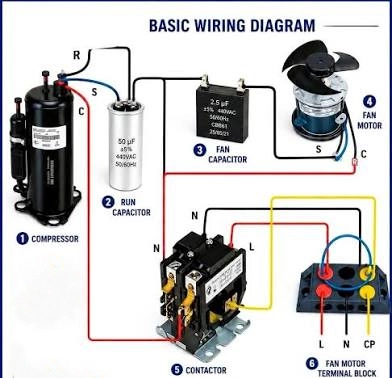
The compressor is where guessing gets expensive, because a failed capacitor and a locked compressor produce the same hum. Copeland’s compressor data definitions describe locked rotor amps as the current the compressor draws if the rotor is locked and cannot move under power, and rated load amps as the reference current used for contactor and wire selection. A clamp reading taken during the start attempt, compared against those two figures, separates the capacitor is starving it from the compressor is locked.
That is also why a hard start kit is the wrong reflex. Copeland’s own application guidance states that start assist devices are usually not required on its ZP K3 and ZP K5 scroll compressors, because the internal compression components always start unloaded. Bolting one onto a low capacitor or a failing compressor buys a few weeks and hides the reading that would have named the problem.
None of these parts fails suddenly. They degrade, and the degradation is measurable long before it becomes a no-cool call on the hottest afternoon of the year.
A capacitor drifts downward from its printed value over years of heat cycling, and a unit will keep starting on a weak one — slower and harder each season — until the morning it will not. Contactor pitting accumulates one arc at a time. A compressor asked to start on a starving capacitor draws high current on every attempt, and that current is what pits the contactor and shortens the compressor’s own life. The chain runs one direction: a cheap part left in place quietly consumes an expensive one.
Taken during routine maintenance, those same readings are trend data. Taken after the unit dies, they are only a diagnosis.
The honest diagnosis here is three measurements: a capacitance reading against the value printed on the can, a clamp reading against the nameplate’s rated-load and locked-rotor figures, and an inspection of the contactor contacts. Those readings name the fault instead of guessing at it — which is why the diagnostic visit is billed work rather than a free lead-generation call. The diagnosis is the value. It is what stops a compressor being condemned over a part that costs a fraction of what replacing it would, and equally what stops a capacitor being sold into a compressor that is already locked. Diagnose before you quote.
Four questions worth asking anyone who quotes you on an air conditioning repair for a dead outdoor unit:
Flat-rate, no-surprise pricing — you see the number before we start the work. Every repair proposal is clearly communicated before any work begins, and we can email your estimate. The service call is charged because the diagnosis is the work: three readings that tell you which of these parts actually failed, and what it will cost to put it right.
Dye’s HVAC technicians are NATE certified and are not paid on commission — nobody here earns more by selling you a compressor. The company holds Indiana Plumbing Contractor License PC#10500518, is Google Guaranteed, and holds 4.8 stars across 410+ Google reviews. Serving LaPorte, LaPorte County, Michigan City, Valparaiso and Northwest Indiana, Monday through Friday 7AM–5PM and Saturday 7:30AM–12PM. Family-owned in LaPorte since 1939 — 87 years in the same town.
If your outdoor unit is silent, humming, or tripping its breaker, Dye Plumbing & Heating serves LaPorte County and Northwest Indiana with same-day emergency response during business hours. You will see the number before any work begins, and we can email your estimate. Book online or call 219-362-6251.
219-362-6251Dye Plumbing & Heating · 1600 Lake Street Suite B, LaPorte, IN 46350 · Indiana Plumbing Contractor License PC#10500518

© Red Barn Media Group 2026